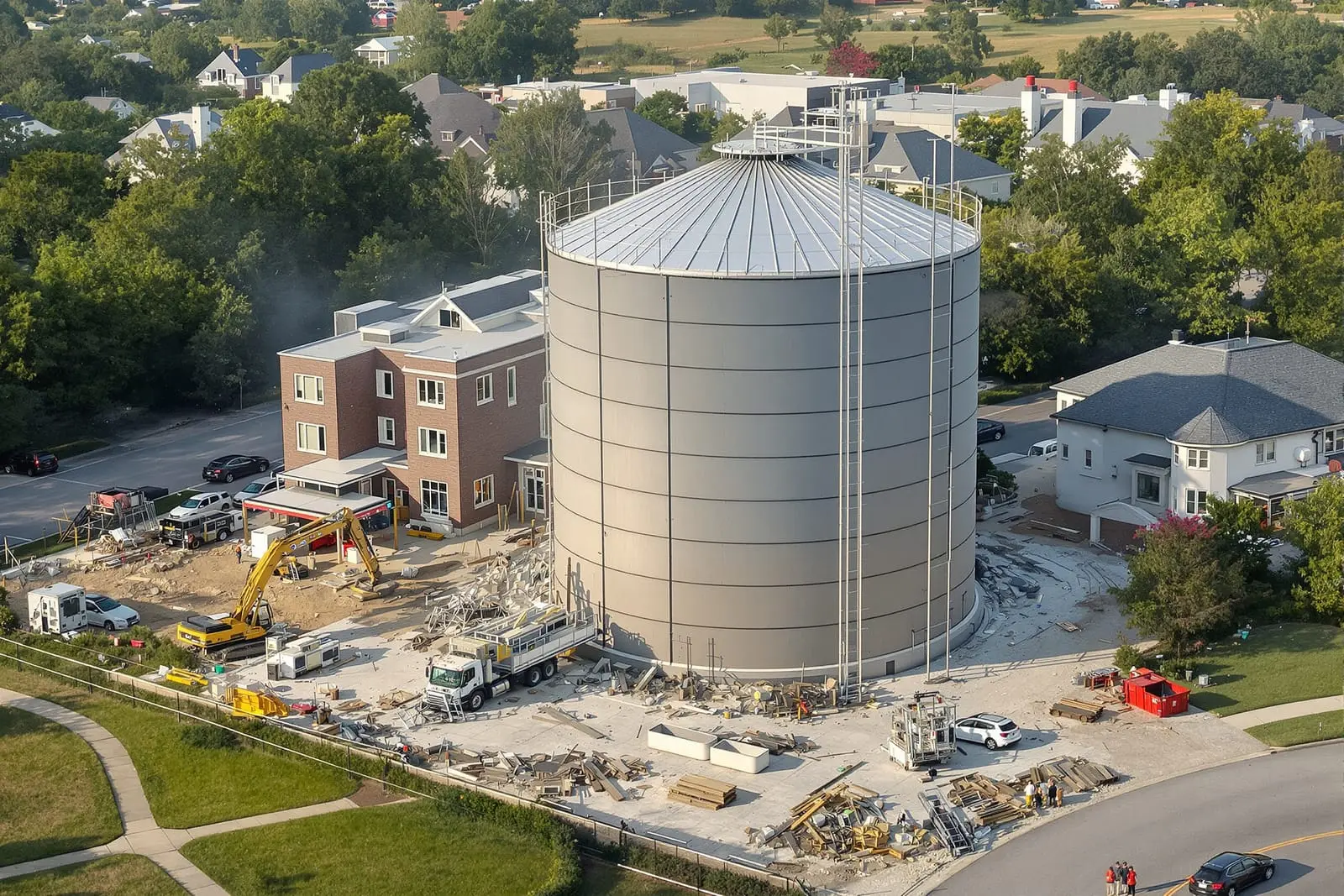
Wrexo Demolition Atlanta performs tank, silo, and stack demolition for industrial sites throughout Atlanta, GA. We dismantle or fell steel tanks, concrete silos, chimneys, and smokestacks using engineered methods. Rigging, cutting, and controlled collapse techniques are selected to protect adjacent equipment and structures.
Wrexo Demolition Atlanta provides professional tank demolition throughout Atlanta, GA and the surrounding area. Our licensed, insured crew delivers safe, clean, on-time work with a free estimate before anything begins. Call (678) 561-8690 or request your free quote.
Tank, Silo and Stack Demolition in Atlanta, GA
Wrexo Demolition Atlanta provides specialized tank, silo and stack demolition services for industrial plants, water treatment facilities, farms, rail yards and commercial properties across metro Atlanta. Our crews are trained to dismantle and remove steel, concrete and composite structures that are no longer safe, efficient or compliant.
In North Georgia, many tanks and silos were built in the 1960s to 1990s. Corrosion from humidity, temperature swings and industrial chemicals often weakens shell plates, support legs and anchor bolts. Our first priority is to make the structure safe to work around, then to remove it in a controlled way that protects workers, adjacent equipment and nearby roads or rail lines.
Whether you need a single 20,000 gallon fuel tank removed or a full battery of concrete silos taken down between active production lines, Wrexo Demolition Atlanta brings the engineering, equipment and local permitting experience to complete the work efficiently and safely.
How Tank Demolition Really Works, Step by Step
Effective tank demolition is planned as carefully as any new construction. We begin with a site visit to measure the tank, document product history and review access for cranes, excavators and haul trucks. We check for live utilities, process piping, electrical feeds and product transfer lines that may still be connected.
If the tank held fuel, chemicals or process liquids, we coordinate cleaning and gas-free certification. Confined space and vapor testing are critical in Atlanta’s hot summers, when vapors expand and can accumulate. We will not cut a tank with hot work until a third-party or in-house gas test shows that the atmosphere inside is safe.
Once the tank is certified clean, we select a demolition method. For most atmospheric steel tanks, we use mechanical cutting with excavator-mounted shears and torches. For elevated tanks, we often bring in a crane and man baskets, cutting the tank down in rings from the top and lowering sections in a controlled sequence. Bolted tanks are commonly taken apart panel by panel to minimize flying debris and noise.
The last phase is slab and foundation removal if the client wants a clean building pad. We break and remove ring walls, piers or pile caps, then backfill and compact to your specs so the area can be repurposed for new construction, parking or laydown.
Silo Demolition for Concrete, Steel and Hybrid Structures
Silos present different challenges than tanks because of their height, slender footprint and internal framing. Around Atlanta we commonly see tall concrete grain silos, aggregate silos at ready-mix plants, and steel silos for plastic pellets, cement and fly ash. Each type requires a different demolition strategy.
For concrete silos, we usually start with internal cleaning to remove residual product and hardened buildup. We then evaluate wall thickness, internal columns and adjacent structures. Depending on clearance and proximity to neighboring buildings, we may use high-reach excavators with concrete processors, controlled section-by-section top-down demolition, or a combination of robotic breakers and saw cutting.
Steel silos are often removed using a sequence of cuts that allow the shell to be lowered or collapsed in a preplanned direction onto an engineered fall zone. In tight Atlanta industrial corridors, we may rig and crane out upper sections instead, cutting them free and lowering them to ground level for further processing.
If your silos are part of an operating plant, Wrexo Demolition Atlanta coordinates work windows to avoid peak production times and truck traffic. Our crews are used to working around conveyor belts, overhead piping and dust collection systems and we plan our cuts so that vibration and impact do not transfer to equipment that needs to stay online.
Stack and Chimney Removal in Active Facilities
Stacks and chimneys for boilers, process exhaust and flares often rise well above surrounding structures. In Atlanta, that means strong wind at the top, frequent summer thunderstorms and strict visibility requirements if you are near flight paths. Safe stack demolition has to account for all of that.
Masonry and reinforced concrete stacks are typically brought down in small sections from the top. We use man baskets, mast climbers or suspended platforms, and workers remove liners, duct connections and appurtenances, then chip or saw cut the shell down ring by ring. For steel stacks, we may use a combination of torch cutting and crane picks or cut and laydown methods, depending on clearance.
We never rely on uncontrolled tipping or “push over” methods in urban or tight industrial settings. Instead, we design a cut pattern that puts the stack on a prepared bed of soil or rubble if a laydown is feasible, or we fully dismantle it at height. Throughout the process we protect adjacent roofs, cooling towers, switchgear yards and public rights of way with exclusion zones, scaffolding protection and debris netting.
Environmental, Safety and Regulatory Considerations in Atlanta
Tank, silo and stack demolition in the Atlanta area is closely tied to environmental and safety compliance. Many older installations include lead-based coatings, asbestos-containing transite stacks, refractory, or PCB-impacted sealants and gaskets. Wrexo Demolition Atlanta performs or coordinates pre-demolition surveys so these hazards are identified before work starts.
If a structure contained fuel, solvents, food-grade oils or dry bulk materials, residues and wash water have to be managed in accordance with local and state regulations. We often work alongside environmental contractors who handle pumping, vacuum truck service and waste profiling, while we focus on the structural removal.
OSHA fall protection and confined space rules drive how we set up platforms, harness systems and rescue plans. Atlanta’s frequent afternoon storms and sudden wind gusts mean that high work is often scheduled early in the day and paused when radar shows lightning in the area. We build weather contingencies into the schedule so you understand realistic completion windows and do not get surprised by delays.
Permits and notifications may be required with the City of Atlanta, Dekalb or Fulton County, and in some cases Georgia EPD, particularly when air permits or emissions points are being permanently removed. Our project managers are familiar with the documentation your environmental team will need for closure reports and audits.
Cost Drivers and Scheduling for Tank Demolition Projects
The cost of tank, silo and stack demolition is driven by more than just height and diameter. Access is often the single biggest factor. If we can bring larger excavators, cranes and haul trucks close to the structure, the work goes faster and costs less. If we must work inside a building, between live structures or under power lines, the work becomes more labor and crane intensive.
Material type and thickness are next. Thick reinforced concrete requires heavier equipment and more time to break, separate rebar and load out. Stainless or alloy steel that cannot be processed easily will also add cost. On the other hand, clean carbon steel tanks often generate scrap value that can partially offset demolition costs.
Contamination and cleaning requirements also impact price. A fuel or chemical tank that has to be steamed, triple-rinsed and gas tested is a different project than a dry grain silo. Waste profiling, manifesting and disposal fees can represent a meaningful portion of the total for some projects.
Seasonal timing matters in Atlanta. Summer heat and storms may limit high work hours. Winter can bring rain that softens the ground and restricts crane setup. Wrexo Demolition Atlanta plans laydown pads, crane mats and temporary access so that weather has less impact. When you request a proposal, have as-built drawings, past inspection reports and product history available; these let us give you a tighter price and schedule.
What to Expect When You Hire Wrexo Demolition Atlanta
From the first call, we focus on understanding your operational needs. Some Atlanta facilities can shut down a tank farm or silo block for a week; others only have narrow outage windows. We build our sequence around your constraints so demolition does not interrupt production, rail schedules or tenant operations.
Our typical project flow includes site assessment, hazard and utility verification, engineering review, written demolition plan, safety and environmental submittals, scheduling and coordination with your team, mobilization of equipment and crews, structural demolition and dismantling, segregation of scrap and waste, load out, final grading or backfill if required, and a walkthrough with your representative.
Communication is constant. You will have a single project manager who provides daily updates and quickly addresses changes such as discovering hidden piping, unknown foundations or unexpected contamination. Because we work regularly in metro Atlanta, we understand local traffic patterns, noise ordinances and neighbor concerns, and we schedule trucking and high-noise activities to minimize disruption.
If you are planning to build on the cleared area, tell us your future use. We can adjust foundation removal depths, backfill materials and compaction levels so your next contractor starts with a reliable pad instead of unknown buried obstructions.
“
Professional tank, silo and stack demolition, done right the first time, quality materials, honest pricing, and results that last.
Wrexo Demolition Atlanta
Tank, Silo and Stack Demolition Across Our Service Area